
Most FinTech products do not lose customers because the interface looks dated. They lose them at the moments where a regulatory disclosure, a fraud check, and a customer’s patience all land on the same screen.
FinTech UX design is shaped less by aesthetic choices than by three structural pressures: compliance, fraud, and trust. Each is legitimate, each has an owner, and each pulls the experience in a different direction. This piece explains how they interact and how product leaders can resolve them deliberately, flow by flow. It applies one angle from our broader view of fintech software development.
What Are the Three UX Pressures in FinTech?
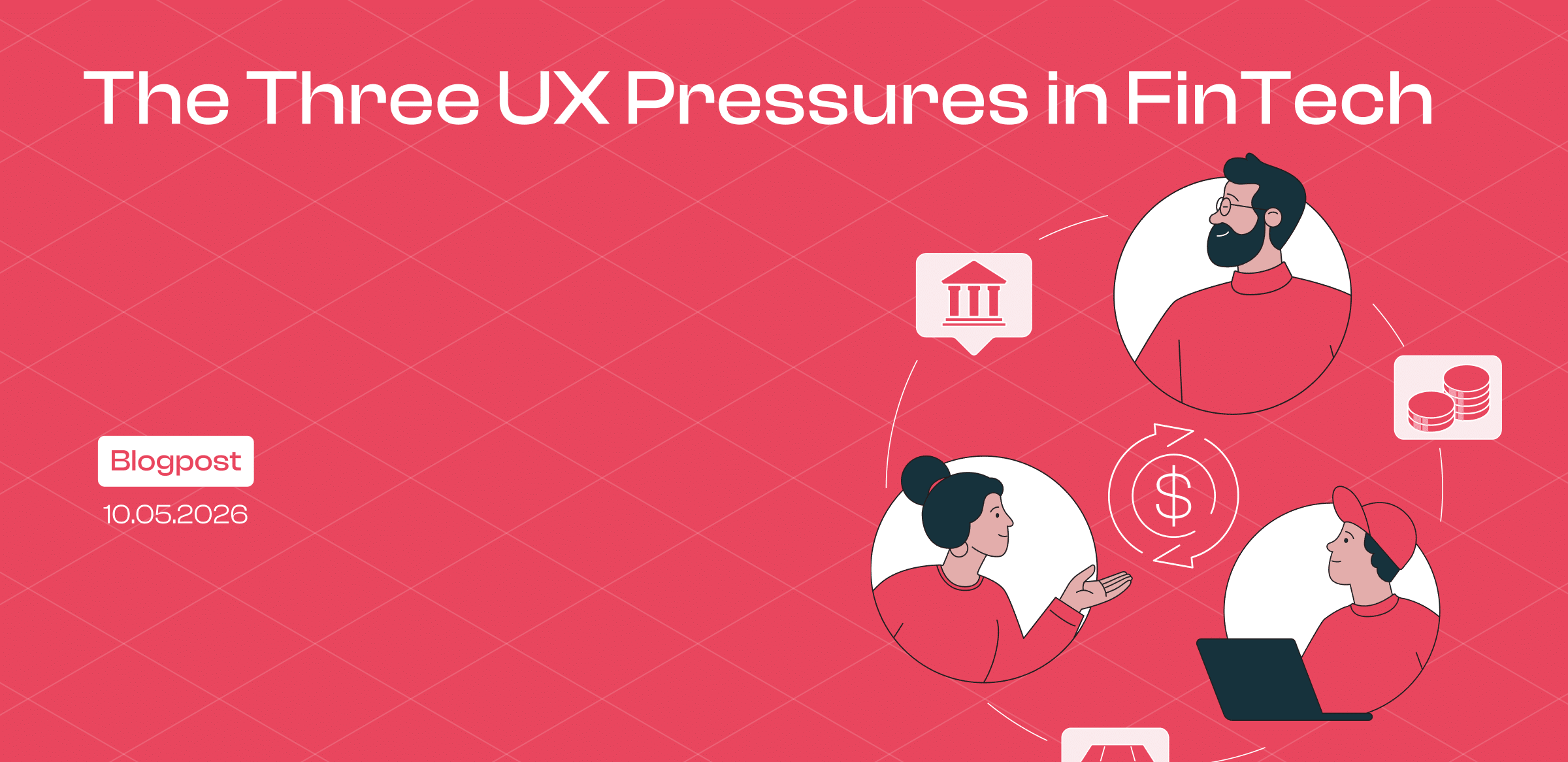
The three UX pressures in FinTech are compliance, fraud, and trust. Compliance dictates what a product must show and record. Fraud dictates what it must verify. Trust dictates how much of either a user will tolerate. Goji Labs calls this the Three-Pressure Model.
Each pressure changes the experience in a predictable way:
- Compliance adds content. Disclosures, consent language, and fee breakdowns must appear at specific moments.
- Fraud adds steps. Identity checks, step-up authentication, and transaction holds all interrupt the flow.
- Trust subtracts tolerance. Every added word and step spends confidence the product must earn back.
The pressures themselves are not the problem. The real problem is ownership. Each pressure belongs to a different team with a different metric. As a result, their disagreements land in the experience by default. Products that scale treat UI/UX design as the arbitration layer, not the final coat of paint.
How Compliance Shapes FinTech UX Design
Compliance shapes FinTech UX design by fixing three things designers do not control. Those are what to disclose, when to capture consent, and what to record as evidence. Designers do control how the product expresses those obligations. That is where most of the value sits.
The common failure is treating legal copy as a block to insert. A fee disclosure in a modal before the confirm button meets the requirement. It also teaches users to click past anything that looks like legal text. Unfortunately, the disclosures users skip are the ones a complaint or an examiner will cite later.
Stronger products design disclosure as part of the decision:
- Fees sit next to the amount they affect, so users understand the cost before they commit.
- Consent appears when it becomes relevant, rather than inside a single sign-up checkbox.
- The record matches the screen. The system logs what the user actually saw, so the interface and the audit trail share one design.
This work sits between legal, product, and engineering. For that reason, UX/UI design consulting delivers the most value before legal finalizes the compliance language.
Why Fraud Controls Are a UX Decision
Fraud controls are a UX decision because every control has a false positive rate. Each false positive is a legitimate customer the product blocked, delayed, or asked for proof of identity. Risk teams track fraud losses precisely. Few organizations track the activation cost of their controls with the same rigor.
Three design choices carry most of that cost:
- Where verification sits. Front-loading every check protects the ledger but suppresses activation. Staged verification tied to risk exposure usually performs better on both measures.
- How the product explains a decline. A blocked payment with no reason creates a support ticket. A clear explanation that protects detection logic preserves the relationship.
- What recovery looks like. A legitimate user who trips a rule needs a defined path back. That path is a product surface, not a support script.
No workshop can settle these choices. They need evidence from real users working through real controls. Usability testing on verification, step-up, and decline flows turns the risk and growth debate into a measured trade-off.
Trust Forms in the Moments Compliance and Fraud Create
Customers decide whether to trust a FinTech product when compliance and fraud controls interrupt them, not when everything works. A held transfer, a verification request, or an unexpected fee is the real test of reliability.
This makes trust an operational attribute, not a brand attribute. Customers trust financial products that behave predictably under stress:
- Clear status while money is in motion.
- Honest timing when something runs late.
- Consistent language across the app, email, and support.
Trust erodes quickly when the interface and the ledger disagree, even briefly. Tolerances also vary by customer. A small business owner waiting on payroll reacts differently than a consumer moving money between accounts. UX research shows which interruptions erode confidence and which ones users accept as protection. Our piece on designing for trust, security, and compliance in FinTech UX covers the interface patterns that follow.
What Changes When a FinTech Product Scales?
The three pressures intensify as a FinTech product scales, because volume exposes trade-offs that held at launch. A flow that worked for early adopters often fails a broader customer mix.
Growth changes each pressure in a specific way:
- Compliance expands. New products, states, and markets add disclosure and consent rules to flows built for fewer.
- Fraud adapts. Bad actors probe the product as it grows, so risk teams tighten rules and add friction.
- Trust thins. Newer customers arrive with less goodwill and less patience for unexplained steps.
These shifts rarely arrive as one decision. Instead, they accumulate as small additions across many teams. Within a few release cycles, a clean onboarding flow can double in length without anyone approving the change.
When Should Product Teams Address the Three Pressures?
Product teams should address the three pressures before they commit to architecture, and again at every major change in scope. The cost of resolving them rises sharply once flows go live.
Four moments call for a deliberate review:
- Before the team fixes the architecture. Disclosure timing and audit logging depend on early system design.
- Before launch. Evidence from verification and decline flows should shape the final release.
- At each new product line or market. New obligations and new risk profiles change the balance.
- After a spike in declines or support tickets. Those signals usually mean a control has drifted out of calibration.
Teams that wait for a complaint or a partner review to start this work pay for it twice. They redesign the flow, and then they rebuild the evidence behind it.
How Product Leaders Resolve the Three Pressures
Product leaders resolve the three pressures by making each trade-off explicit, owned, and measured at the flow level. The Goji Labs approach uses a method we call pressure mapping. It scores every critical flow on three factors: its compliance obligations, its fraud controls, and the trust cost of each.
Five flows carry most of the risk in a typical FinTech product:
- Onboarding and identity verification
- Account funding
- The first transaction
- A declined or held transaction
- Account recovery
Mapping these first often reveals steps that carry obligations better handled elsewhere. It also surfaces controls tuned for a risk profile the product has outgrown. The output is a decision record, not a redesign. Each flow gets a named owner per pressure, an agreed trade-off metric, and a review cadence.
For products already in market, a UX audit is the fastest way to set that baseline. It shows where the current experience absorbs costs no team agreed to carry.
Final Thought
Compliance, fraud, and trust will never stop competing for the same screens. They should not, because each one protects something real. The difference between products that scale and those that stall is intent. Strong teams design that competition deliberately. Others leave it to resolve itself in production, where customers absorb the cost first.
If verification friction or disclosure fatigue is costing you customers, start by mapping where the three pressures collide today. We work with product leaders to score their highest-risk flows and assign ownership for each trade-off. Then we prioritize the changes that protect both compliance and activation. Book a call with us and we will walk through your most exposed flows with you.