
Most AI systems don’t break because of the model.
They break at the handoff.
Between input and output, there’s a gap – where decisions are made, actions are taken, and teams interact with the system. That’s where AI either becomes useful or irrelevant.
AI workflows are what close that gap.
AI doesn’t create value on its own. It creates value when it fits into how work actually gets done.
AI Workflows Are Not Just Automation
Many teams treat AI workflows as simple automation:
- input → process → output
But real operational systems are not linear.
They involve:
- multiple decision points
- dependencies across teams
- conditional logic
- human oversight
This is why AI workflow automation is not just about moving data – it’s about coordinating decisions, actions, and context across a system.
Where AI Workflows Actually Live
AI workflows don’t sit in isolation.
They exist inside:
- product experiences
- internal operations
- customer-facing processes
- cross-functional systems
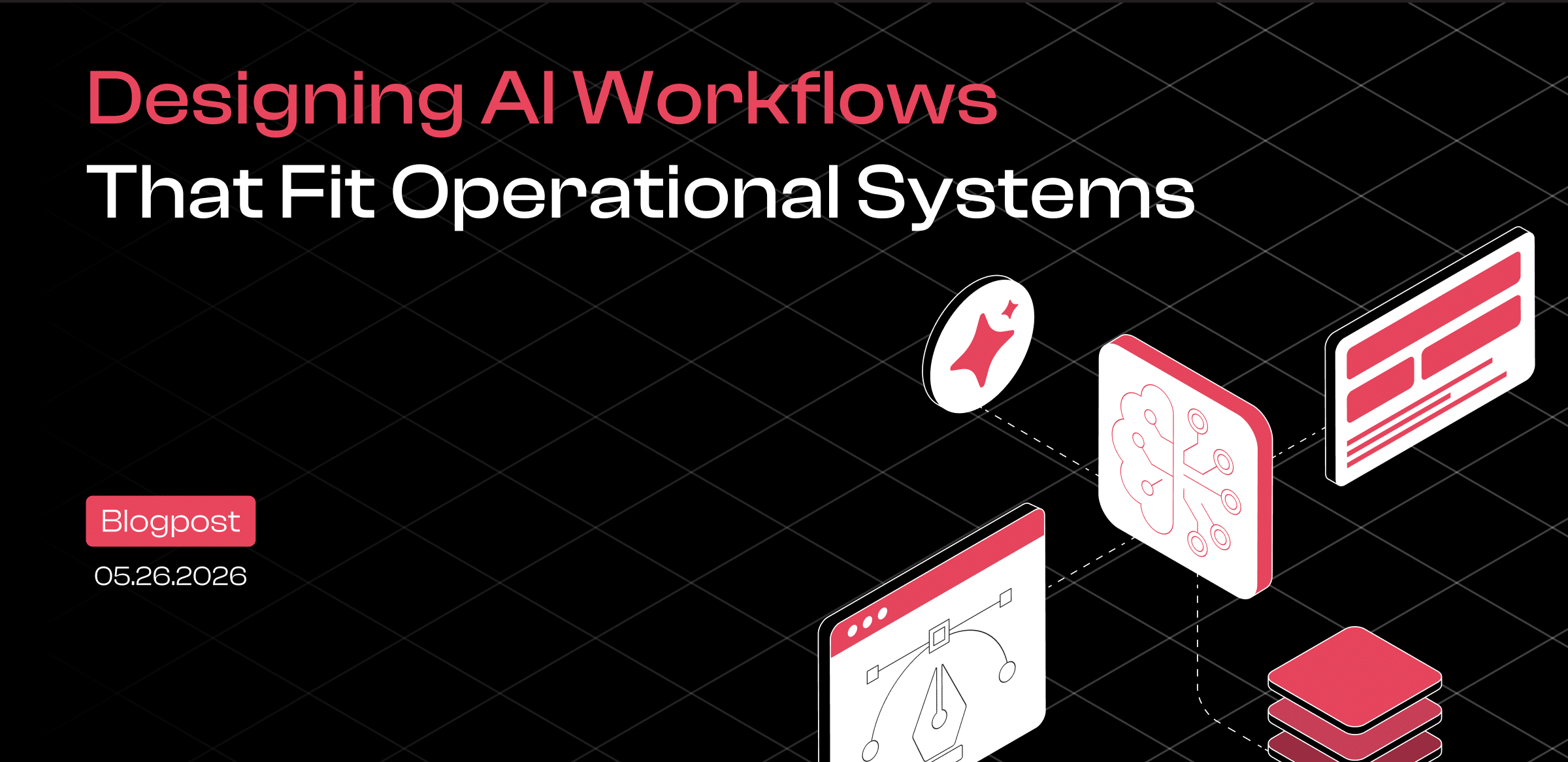
A useful way to think about it:
- Inputs → data, user actions, system triggers
- Processing → models, logic, retrieval
- Decisions → what the system recommends or determines
- Actions → what actually happens next
If any part of that chain is unclear, the workflow breaks down.
The Four Parts of a Functional AI Workflow
To work in production, AI workflows need more than logic – they need structure.
1. Clear Inputs
AI systems depend on the quality and consistency of inputs.
- Are inputs structured and predictable?
- Do they reflect real-world conditions?
- Are edge cases accounted for?
This is where a strong AI data layer and infrastructure becomes critical.
Without clean inputs, everything downstream becomes unreliable.
2. Defined Decision Points
AI should not replace every decision.
It should support the right ones.
- What decisions are automated?
- What decisions require human review?
- Where does the system escalate uncertainty?
This is where many workflows break – not because the system is wrong, but because decision boundaries are unclear.
3. Actionable Outputs
Outputs must lead to action.
- What happens after the system produces a result?
- Who acts on it?
- How is it integrated into existing tools?
This is where AI assistants – like chatbots and copilots – often serve as the interface between output and execution.
4. Feedback and Iteration
Workflows are not static.
They improve over time.
- How are errors captured?
- How is feedback incorporated?
- How is performance measured and refined?
This is where AI optimization and continuous improvement become part of the workflow itself.
Why Most AI Workflows Never Scale
Early workflows often work in controlled environments.
But when they move into production, complexity increases:
- more users
- more edge cases
- more dependencies
- more variability
This is where workflows lose consistency – not because the model changes, but because the surrounding system isn’t designed for scale.
Designing for Real Operational Conditions
Effective AI workflows are designed with constraints in mind:
- imperfect data
- incomplete context
- human variability
- system dependencies
They don’t assume ideal conditions.
They are built to function despite them.
This is where AI product development becomes critical – ensuring workflows are not just functional, but resilient.
From Workflow to System
A single workflow can improve a task.
A system of workflows transforms an operation.
This requires:
- alignment across teams
- shared data structures
- consistent decision logic
- coordinated execution
This is how AI moves from isolated improvements to meaningful impact across an organization.
The Role of Prototyping in Workflow Design
Before scaling workflows, they need to be tested.
- Where does the workflow break?
- Where do handoffs fail?
- Where does human intervention become necessary?
This is where AI prototyping and rapid validation helps teams understand not just whether AI works – but how it behaves in real systems.
Final Thought
AI workflows are where systems meet reality.
They determine whether AI becomes:
- a useful part of operations
- or another disconnected feature
The difference is not the model.
It’s how decisions, actions, and teams are connected.
Because in real-world systems, AI doesn’t operate alone.
It operates inside workflows – and those workflows determine whether it actually works.