


A Unified Risk Management Platform for Sewer Utilities.
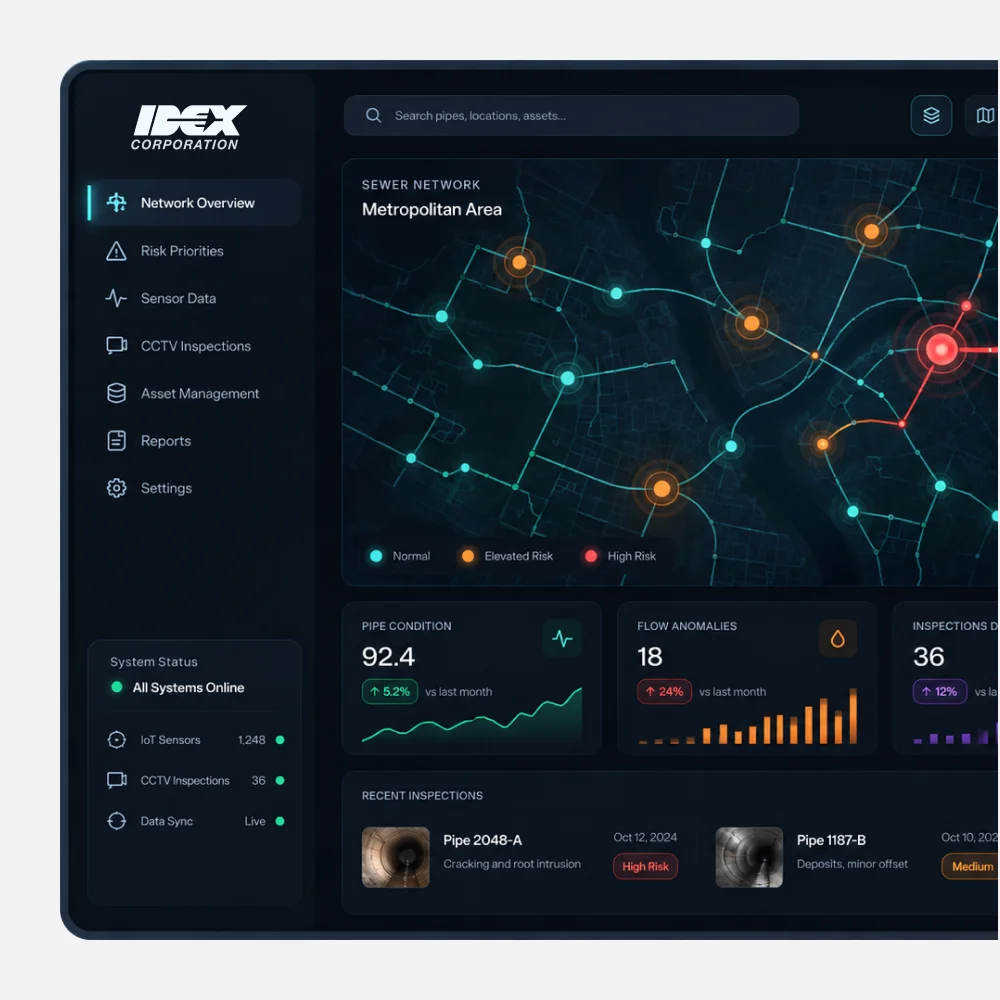
IDEX’s environmental-monitoring business helps utilities run their sewer systems. But its customers were stuck with two products that never talked to each other: continuous IoT sensor data on one side, episodic CCTV pipe inspections on the other. Goji Labs ran the technical and strategic work behind Perispek. We audited both systems and mapped where the data could, and couldn’t, be combined. Then we built the risk-scoring logic that turns it into one prioritized list.

The Challenge
IDEX’s two products don’t just hold different data. They run on different clocks.
One streams continuous telemetry: flow rates, water levels, overflow signals. Users check it once or twice a week. The other captures a snapshot: a CCTV inspection scores pipe condition on a 1-5 scale, current only as of the day a crawler last ran through it. That could’ve been 3 years ago.
Only a handful of customers run both systems. And even they had no shared view. An engineer deciding where to send a crew had to open two tools and cross-reference asset IDs by hand. Then weigh a live alert against inspection data that might be years stale.
Everyone’s first instinct was “merge the data.” Nobody had answered the harder question: how does a defect from 3 years ago progress under the flow that pipe has actually seen since? What do you infer about a pipe that’s never been inspected at all? Those are hydrology and materials-science questions. No one had funded the work to answer them before design started. IDEX needed a partner to sort out what could be built now from what needed research nobody had done.

Our Approach
We audited both systems before designing anything on top of them. Live production, not documentation. IDEX’s own draft requirements didn’t answer the workflow questions that mattered.
At the same time, we ran interviews and on-site workshops with utility staff. A pattern showed up we didn’t expect: multiple customers, unprompted, described wanting a “decision tree.” Feed it criteria and history, get back a risk warning. That’s a product decision, sitting inside what looked like a data-integration project.
So we drew a hard line between 3 things everyone kept calling “merging the data.” A join on the shared spatial key both systems already have (a pipe’s location on the utility’s GIS), cheap and worth most of the value on its own. A short list of named cross-source computations, like flow-versus-rainfall correlation and defect clustering, where combining 2 specific numbers in a hand-built formula earns its cost. And general algorithmic fusion, reconciling continuous telemetry against episodic inspection history into one model. We flagged that last one as a research problem, not an MVP feature, and cut it.
That framework is what let IDEX scope a real MVP instead of chasing a fusion engine with no clear output. On top of it, we built the risk-scoring model (likelihood times consequence, weighted by pipe age, material, and population impact), the alert taxonomy split across what each data source is actually good at, and the per-customer configuration layer, needed because every utility’s GIS schema is set up differently.
We took the framework past a slide deck and built it into a working, clickable prototype: a real map, real data, scenarios people could click through instead of debate in a room. When IDEX’s internal build and our design started to diverge, that prototype is what both sides pointed back to as the reference. And when the work reached IDEX’s leadership team, it gave them something concrete to react to and sign off on, not another set of options to defer.

The Impact
The framework didn’t just describe the problem. IDEX’s engineering team used it to scope and build the platform after we handed off. The 3-tier data-fusion model (join, named computation, deferred research) gave them a shippable MVP instead of an open-ended integration project, and a data-silo complaint became a validated product thesis after 3 separate customers described the same unmet prioritization need, unprompted.
The risk-scoring model we designed (likelihood times consequence) became the platform’s core differentiator, later adopted and refined by IDEX’s own engineers. We flagged the architecture risks before a line of code got written: per-customer GIS mapping, auth split across 2 source systems, inconsistent API availability. And months of back-and-forth turned into a working prototype leadership could react to directly, helping carry the platform toward a company-wide go-forward decision. Utility customers rated that prototype 4 out of 5 on usability. Their existing tools scored 2-3.
- A 3-tier data-fusion model that made an MVP shippable
- A risk-scoring model IDEX’s engineers adopted as the core differentiator
- Architecture risks flagged before a line of code was written
- A clickable prototype leadership could react to and sign off on
- 4 out of 5 on usability, against 2-3 for the tools it replaces


